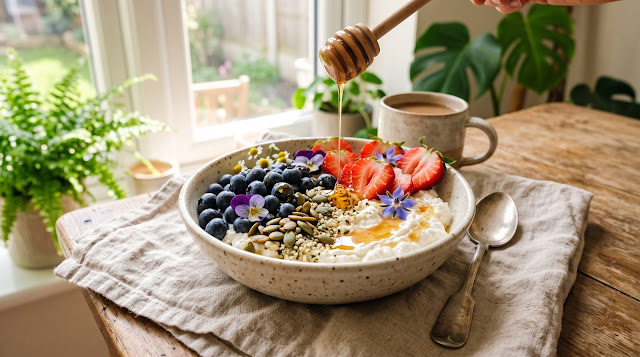
Somewhere between the protein-obsessed fitness world and the aesthetic slow-living breakfast world, there is a gap. The protein crowd eats cottage cheese straight from the container over the sink. The slow-living crowd arranges microgreens on avocado toast but ends up hungry by 10am. Both are doing something right. Neither is doing both at once.
This bowl is the version that does both.
Whipped cottage cheese as a base — creamy, almost mousse-like when blended, nothing like the grainy refrigerator staple you remember — topped with seasonal berries, seeds, a drizzle of raw honey, and whatever else the morning calls for. It comes together in four minutes. It sits beautifully in a ceramic bowl. It delivers 25 to 35 grams of protein before you’ve opened your laptop. And it has the kind of visual quality that makes you want to eat at a table instead of standing at the counter.
That last part matters more than it sounds. Because how you eat breakfast shapes the whole morning more than what you eat for breakfast.

Why High Protein Breakfast Is the One Nutrition Shift Worth Making in 2026
The protein-at-breakfast conversation has moved well past fitness culture and into mainstream nutrition science — and for good reason. The evidence is consistent enough to take seriously.
Protein is the most satiating macronutrient by a significant margin. A high-protein breakfast reduces hunger hormones — specifically ghrelin, which drives appetite — for four to six hours, compared to two to three hours for a carbohydrate-dominant breakfast. This isn’t a subtle difference. It’s the difference between feeling satisfied until lunch and standing in front of the fridge at 11am not knowing what you want but knowing you want something.
Protein in the morning also blunts the cortisol awakening response — the natural cortisol spike that happens in the first 30 to 45 minutes after waking. When cortisol has protein to work with, it stabilizes. When it doesn’t — when you eat sugar, or nothing, or just coffee — the spike extends and amplifies, which for many people shows up as mid-morning anxiety and difficulty concentrating. If you frequently wake up with elevated stress, explore our complete guide on Anti-Inflammatory Breakfast for Anxious Mornings to help soothe your nervous system.
And for muscle maintenance and body composition: muscle protein synthesis — the process by which your body repairs and builds muscle tissue — is most responsive to protein intake in the morning, particularly after the overnight fast. Spreading protein across meals rather than loading it at dinner means your muscles get what they need when they can actually use it.
The target for a high-protein breakfast is 25 to 35 grams. This bowl hits it without supplements, without protein powder, without anything that requires reading a label for ingredients you can’t pronounce.

Why Cottage Cheese — And Why It’s Different Now
Cottage cheese has had a reputation problem for decades. It’s the diet food from the 1970s. The sad lunch on the plate next to canned peaches. The thing your grandmother ate while watching her weight.
Two things have changed. First, the food itself: small-curd full-fat cottage cheese from good dairy — Good Culture is the brand most often cited, but any version with live cultures and minimal ingredients works — tastes genuinely different from the watery, gummy commercial versions most people grew up with. Cleaner, fresher, with a slight tang that works beautifully with fruit and honey.
Second, the technique: whipping it. Thirty seconds in a blender or food processor transforms cottage cheese from textured and chunky to smooth, creamy, and almost identical in consistency to Greek yogurt — but with notably higher protein per gram. Full-fat Greek yogurt has about 10 grams of protein per 100g. Full-fat cottage cheese has 11 to 12 grams per 100g, with a creamier texture when whipped and a more neutral flavor that takes on whatever you put with it.
One cup of cottage cheese: approximately 25 grams of protein. Add hemp seeds: another 10 grams. Add an egg or Greek yogurt on the side if you want to push to 35+. The math is straightforward and the result is genuinely satisfying in a way that overnight oats — which most people love but which plateau in the satiety department — rarely is.
The Base Recipe: Whipped Cottage Cheese Bowl
This is the foundation. Everything else in this article is a variation on this base.
What you need (serves 1):
- 1 cup (225g) full-fat cottage cheese — full-fat matters, both for flavor and because fat-soluble vitamins require dietary fat to absorb
- ½ tsp vanilla extract
- 1 tsp raw honey (optional — the vanilla alone makes it sweet enough for most people)
How to whip it:
Blend in a small blender, food processor, or with an immersion blender for 20 to 30 seconds until completely smooth. It will go from grainy and chunky to silky and thick. Pour into your ceramic bowl. This step takes 90 seconds including cleanup if you rinse the blender immediately.
If you don’t have a blender: a fork and some patience gets you 80% of the way there. It won’t be perfectly smooth but it’ll taste the same.
The protein count at this stage: approximately 25 grams.
5 Aesthetic Topping Combinations (Seasonal and Intentional)
1. Summer Berry and Bee Pollen (June – August)
The most photographed version and the easiest to understand why. The contrast between the white whipped base and the deep red and purple of summer berries is one of those visual combinations that doesn’t require any skill to make beautiful — it just is.
- ½ cup mixed berries: strawberries sliced, blueberries whole, raspberries whole
- 1 tbsp hemp seeds — pressed gently into the surface so they don’t roll off
- 1 tsp bee pollen — the golden color against the white and berry is striking, and bee pollen is genuinely anti-inflammatory and rich in amino acids
- Drizzle of raw honey in a slow spiral
- Optional: 2–3 fresh mint leaves
Total protein with hemp seeds: approximately 28 grams.
2. Autumn Spiced Pear and Walnut (September – November)
The warm version. Cottage cheese base with vanilla, topped with pear that’s been quickly cooked — three minutes in a pan with a knob of butter, cinnamon, and a splash of maple syrup until just softened and caramelized at the edges. The warm pear against the cool whipped base creates a temperature contrast, offering a similar slow, grounding vibe to our signature Slow Morning Kitchen Ritual.
- 1 small pear, thinly sliced, pan-cooked as described
- Small handful of walnuts, roughly broken
- 1 tbsp pumpkin seeds
- Pinch of cinnamon over the top
- Optional: a few dried cranberries for color and tartness

3. Green and Seed (Year-Round, High-Protein Focus)
The savory direction — surprising to people who assume cottage cheese is always sweet, but traditional in many Eastern European and Middle Eastern food cultures where dairy and vegetables are natural partners. This version sits closer to 35 grams of protein and works particularly well for people who find sweet breakfasts leave them wanting more sweetness through the morning.
- Whipped cottage cheese base — no vanilla, no honey
- Instead: a pinch of flaky salt, cracked black pepper, a few drops of good olive oil stirred in before whipping
- Top with: sliced cucumber, halved cherry tomatoes, everything bagel seasoning
- 2 tbsp hemp seeds pressed into the surface
- Optional: a soft-boiled egg halved on the side — adds another 6 grams of protein and the visual of the orange yolk against white is exactly right
Total protein: approximately 33–35 grams with the egg.
4. Tropical Mango and Coconut (Winter Brightness)
The version for January and February when you need color and something that feels like somewhere else. Frozen mango thaws to room temperature in 20 minutes the night before (or microwave briefly) and has a sweetness and acidity that cuts through the richness of the cottage cheese base beautifully.
- ½ cup mango, diced (fresh or thawed from frozen)
- 1 tbsp unsweetened coconut flakes, toasted
- 1 tbsp chia seeds
- Squeeze of lime juice over everything
- Optional: a few slices of kiwi — the vitamin C supports iron absorption and the green against the orange is visually striking
5. Dark Cherry and Cacao Nib (Luteal Phase / Pre-Period)
This is the bowl for the week before your period — if you track your cycle, this is the version to reach for when you’re craving chocolate and don’t entirely know why. The cherries contain melatonin and anthocyanins that reduce inflammation and support sleep in the luteal phase. The cacao nibs deliver magnesium and theobromine without the sugar of chocolate. If you want a complete look at utilizing seeds and foods to support your cycle, explore our Hormone Balancing Breakfast Routine Guide.
- ½ cup frozen cherries, thawed (or briefly warmed in a pan)
- 1 tbsp raw cacao nibs
- 1 tbsp hemp seeds
- Drizzle of raw honey
- Optional: pinch of cardamom — pairs beautifully with cherry and adds warmth

The Morning Ritual Around the Bowl
The bowl takes four minutes to make. What makes it a ritual rather than just a fast breakfast is the five minutes around it.
The sequence that works: blend the cottage cheese first — it takes 90 seconds. While the blender runs, put the kettle on for tea or matcha. While the water heats, arrange the toppings on the bowl. By the time the drink is ready, the bowl is ready. Sit down before you pick up your phone. Eat looking out the window or at something still. Not a screen.
This isn’t about being precious. It’s about the fact that digestion works better when you’re not in stress mode, that the first ten minutes of the morning set a tone that’s surprisingly durable, and that a breakfast you actually sit down to eat tends to satisfy more than the same breakfast eaten standing up — even when the food is identical. The nervous system registers the pace of eating, not just the content of it.
The protein in this bowl keeps you full until lunch without effort or willpower. The ritual around it keeps you grounded through the morning without meditation or journaling or any other practice you have to remember to do. Both of those things happen at once, at the same table, with the same bowl.
How to Meal Prep This for the Whole Week
The whipped cottage cheese base keeps well in the fridge for four to five days in a glass jar with a tight lid. Make a large batch on Sunday — blend a full 500g container with vanilla and a little honey — and it’s ready every morning with zero effort. Add toppings fresh each day.
This is the meal prep approach that actually works for busy weeks: the base is already done, the toppings vary by what’s in season and what you feel like, and the whole thing from fridge to table takes under three minutes. Less decision-making in the morning means less cortisol. Less cortisol means a better morning. The whole thing compounds.
What to prep alongside it:
- Wash and dry berries — stored in a glass container in the fridge, ready to grab
- Toast coconut flakes and pumpkin seeds in a dry pan for five minutes — stored in a small glass jar, adds crunch without effort mid-week
- Soft-boil a batch of 6 eggs — keeps in the fridge for 5 days, adds protein to any version of the bowl instantly
4 Variations for Different Goals and Lifetyles
- For post-workout mornings: Add a soft-boiled egg alongside, increase hemp seeds to 2 tablespoons, add a tablespoon of almond butter stirred into the base before whipping. Pushes to 35–40 grams of protein — appropriate recovery nutrition after a morning run or gym session.
- For hormone balance (follicular phase): Base + pumpkin seeds + blueberries + flaxseed ground and stirred into the base. The flax lignans support estrogen metabolism; the pumpkin seeds add zinc for the first half of the cycle.
- Fully dairy-free version: Swap cottage cheese for thick coconut yogurt — protein count drops to about 5–6 grams from the base, so compensate with 3 tablespoons hemp seeds (10g protein) and a side of two soft-boiled eggs. Different nutritional profile, same aesthetic.
- For kids or picky eaters: The sweet version with honey, vanilla, strawberries and a drizzle of nut butter is frequently mistaken for dessert. The protein and satiety benefits apply regardless of age — it’s genuinely one of the better ways to get children through the morning without a pre-lunch energy crash.

FAQ: High Protein Cottage Cheese Breakfast Bowl
Is cottage cheese actually high in protein compared to Greek yogurt?
Very comparable, with some advantages depending on the type. Full-fat cottage cheese contains roughly 11–12g of protein per 100g and typically fewer added ingredients than flavored Greek yogurts. Plain full-fat Greek yogurt is similar at 9–10g per 100g. The main practical difference: whipped cottage cheese has a creamier, more neutral flavor that takes on toppings more readily, and many people find it more filling per calorie due to the casein protein content, which digests more slowly than whey.
Does cottage cheese have to be blended, or can I eat it as-is?
You can absolutely eat it as-is — the nutrition is identical. Blending is purely a texture preference. If the curd texture doesn’t bother you, skip the blender entirely. If you’ve avoided cottage cheese because of the texture, the whipped version is often the thing that changes that — it’s a genuinely different eating experience.
How much protein do I actually need at breakfast?
The research most often cited suggests 25–35 grams for optimal satiety and muscle protein synthesis in the morning. Most people eat significantly less than this without realizing it — a bowl of oats with berries typically contains 6–8 grams. The gap between what most people eat and what actually keeps them satisfied through the morning explains a lot of mid-morning hunger, sugar cravings, and the particular phenomenon of being ravenous by 11am despite having eaten at 7:30.
Can I make this the night before?
The whipped base: yes, keeps 4–5 days refrigerated. The toppings: add fresh in the morning. Berries stored on whipped cottage cheese overnight become watery and the presentation suffers. The base prep takes 90 seconds; keeping toppings separate is worth it.
Is full-fat cottage cheese better than low-fat?
For this recipe specifically: yes, full-fat whips better and tastes significantly better. Nutritionally, the difference is a matter of ongoing debate — the saturated fat in dairy doesn’t appear to carry the cardiovascular risk once attributed to it in current research, and the fat content supports fat-soluble vitamin absorption and satiety. If you have a specific medical reason to limit saturated fat, low-fat works mechanically — the texture will be slightly less creamy but still good.
The gap between a breakfast that keeps you running until noon and one that leaves you snacking by 10am is usually about 20 grams of protein. That’s what this bowl closes. Four minutes in the morning, one ceramic bowl, ingredients you can keep stocked without effort.
The ritual around it — the slow arrangement, the table, the quiet first ten minutes — isn’t extra. It’s what makes the breakfast land differently than eating the same food over the sink. Both matter. Neither one is complicated.
Start tomorrow. See what the morning feels like when it starts with something that actually holds.
📌 High protein breakfast ideas, slow morning rituals, and aesthetic bowl inspiration — posted daily on Pinterest. Follow NourishRituals here and build your collection of mornings worth saving.