

The 5-minute grounding ritual is the fourth post in the 5-Minute Ritual series, and this one’s for the moment that doesn’t wait for evening or a workout or a meeting — it just shows up in the middle of an ordinary Tuesday, when everything on your plate suddenly feels like too much at once. I used to just push through those moments, which mostly meant staying wired and scattered for the next hour instead of actually resetting. This ritual is what I do instead now, and it’s less about the drink itself and more about what you do while you’re holding it.
Same rule as the rest of the series: five real minutes, nothing that requires more than boiling water, built around one specific kind of moment rather than being a vague “self-care” suggestion.

Jump to: Why a warm drink helps · How to notice you need this · The 5-minute build · 4 variations · Why this is different · FAQ
Why a Warm Drink Actually Helps, Beyond Just Feeling Nice
There’s a real physiological reason a warm mug in your hands does something a cold glass of water doesn’t. According to clinical research on vagus nerve stimulation and parasympathetic regulation, warmth against your skin, especially in your hands and around your mouth as you sip, is registered by your nervous system as a mild, pleasant signal, helping shift your body out of a stressed state into a calmer one.
The sipping itself matters just as much as the temperature. Drinking something hot naturally slows your breathing down, since you have to pause and exhale slightly before each sip to avoid burning your mouth. That small, repeated pause is doing real work — slow, extended exhales are one of the most reliable ways to manually engage the same vagal, parasympathetic response, which is part of why so many breathing techniques for anxiety emphasize a longer exhale than inhale.
Ginger and lemon aren’t doing the heavy lifting here the way the warmth and breathing are, but they’re not nothing either. Ginger has a long history of settling an unsettled stomach, similar to how we use our 5-minute honey lemon ginger tea for immunity, while the bright citrus scent of lemon offers a mild mood-lifting effect through smell alone.
How to Notice You Actually Need This
Part of what makes this ritual easy to skip is that overwhelm rarely announces itself clearly. It usually shows up as small physical signals first — your shoulders creeping up toward your ears, your jaw tightening, a shallow, high breath that barely moves your chest instead of your belly, or that specific restless feeling where you open five tabs and close them all without reading any of them. Catching it at that stage, before it turns into a full spiral, is when this ritual does the most good. Waiting until you’re already at the edge still helps, but it asks more of the five minutes than catching it early does.
Building Your 5-Minute Grounding Ritual
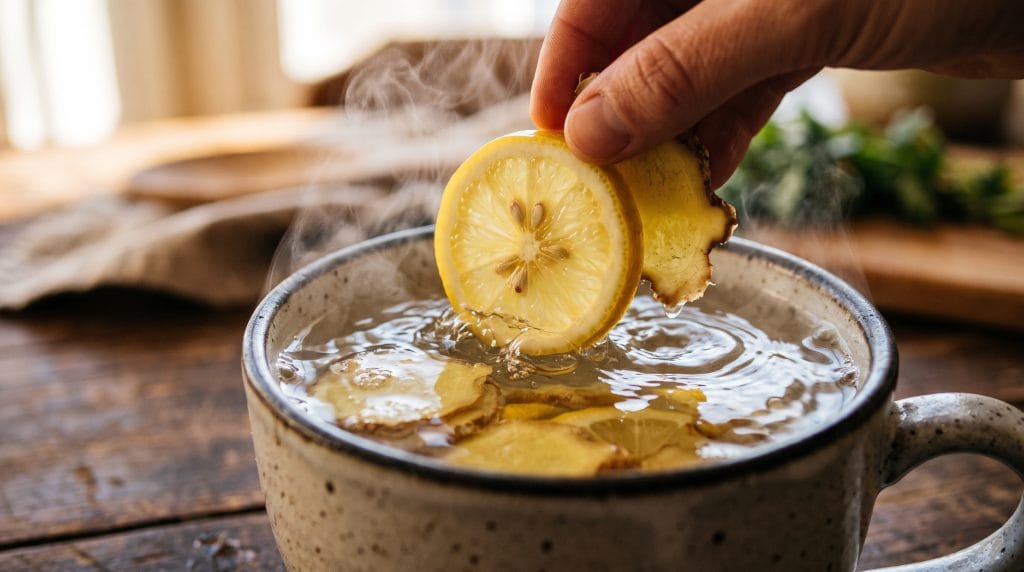
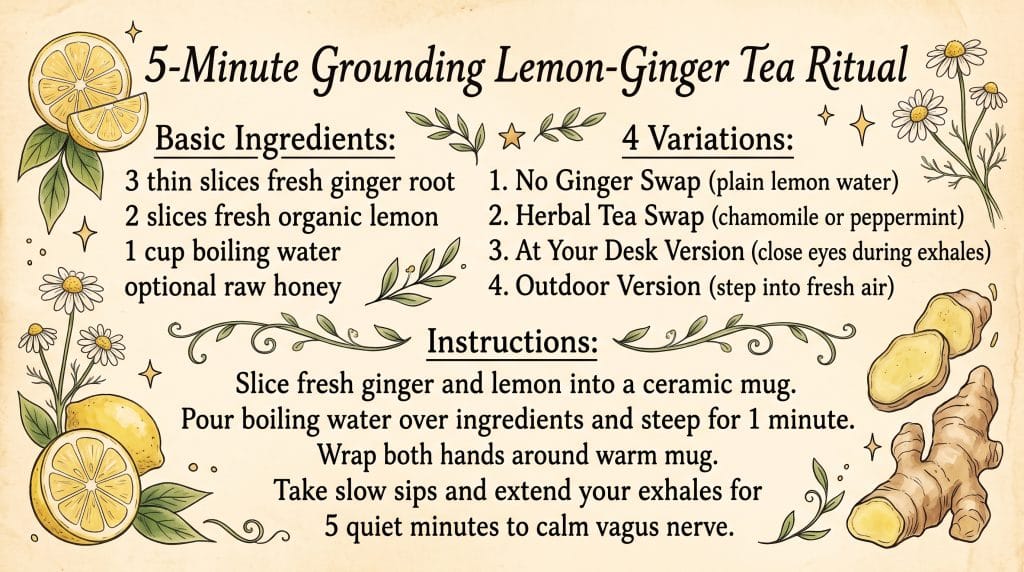
Boil water and pour it over a few thin slices of fresh ginger and lemon in a mug — no need to measure precisely, just enough of each to see the color and steam start to shift. Let it steep for a minute while you find somewhere to actually sit down, even if it’s just turning your chair away from your desk.

Wrap both hands fully around the mug. Take a slow sip, and as you exhale afterward, let that exhale run a little longer than the breath you took in before it. Repeat that for the next four minutes — sip, slow exhale, sip, slow exhale — without reaching for your phone in between. That’s the entire ritual. It’s not about finishing the tea. It’s about what five minutes of that specific rhythm does to your nervous system in the middle of an otherwise chaotic day.
4 Variations to Fit the Moment
No ginger on hand — plain hot water with just lemon works almost as well. The warmth and the breathing pattern are doing most of the actual work regardless of what’s steeped in the mug.
Caffeine-free swap — chamomile or peppermint tea bags work just as well as the fresh ginger-lemon version if that’s what’s already in your kitchen.
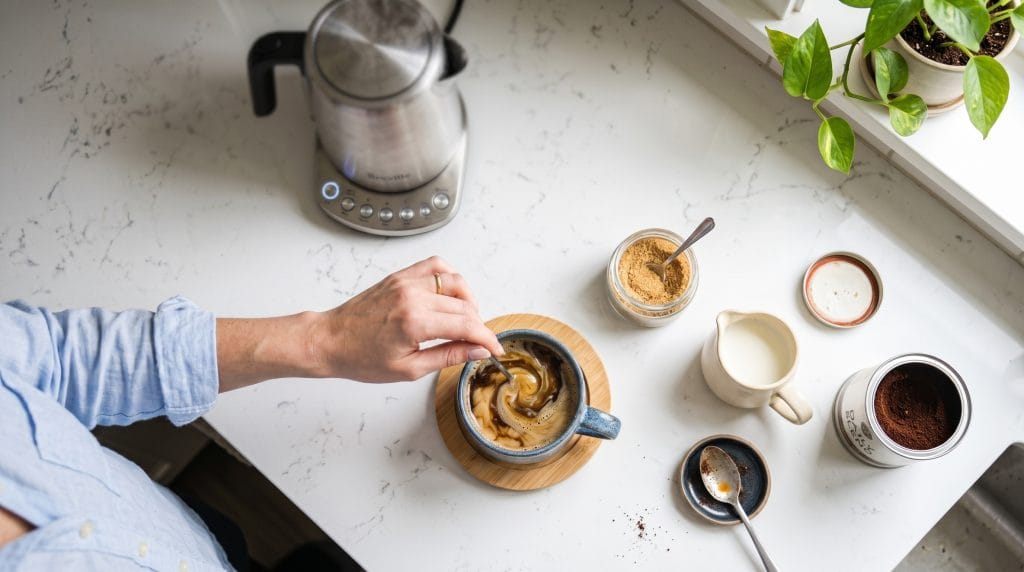
At your desk — if stepping away genuinely isn’t possible, keep the mug at your desk, but still close your eyes for each exhale and resist checking a screen during the five minutes. The ritual still counts even without changing location.
Outdoors — take the mug outside or near an open window if the weather allows. Fresh air adds a small additional calming effect on top of everything else this ritual is already doing.
Why This One’s Different From the Wind-Down Ritual
It’s worth noting how this compares to the first post in this series, since both involve a moment of deliberate calm. The 5-minute wind-down ritual was built for the end of the day, easing you toward sleep over a longer runway. The 5-minute focus ritual was built to keep you steady and alert. This one is built for the middle of an active day, meant to reset you just enough to keep going rather than shut down — five minutes, then back to whatever you were doing, hopefully steadier than before you stopped.
Frequently Asked Questions
Does this actually work, or is it just a placebo from taking a break?
Both pieces are real. Taking any deliberate break helps simply by interrupting a stress spiral, and the specific combination of warmth, slow sipping, and extended exhales adds a genuine physiological calming effect on top of that general benefit.
How is this different from just taking a coffee break?
Coffee itself can add to physical stress activation for some people, especially on top of an already elevated heart rate from stress, and a typical coffee break usually still involves scrolling a phone or continuing a conversation. This ritual specifically asks for five minutes without either of those things, which is really the core difference.
Can I do this more than once a day?
Absolutely — there’s no real limit. Some people find it most useful as a scheduled midday reset, others reach for it only when they notice things starting to feel like too much, and either approach works.
What if I don’t have five uninterrupted minutes?
Even ninety seconds of the same slow-sip, long-exhale pattern captures a meaningful part of the benefit. Five minutes is the ideal, not a strict requirement.
Is this a substitute for actually addressing what’s causing the stress?
No, and it’s not meant to be. This is a short-term reset for an in-the-moment overwhelmed feeling, not a fix for an ongoing source of stress. If that’s what you’re dealing with, it’s worth addressing the underlying issue directly, and talking to a therapist or doctor if it’s a persistent pattern that shows up often enough to interfere with your day-to-day life.

More moments, more rituals — the rest of the series lives over on @Nourish_Rituals.
