
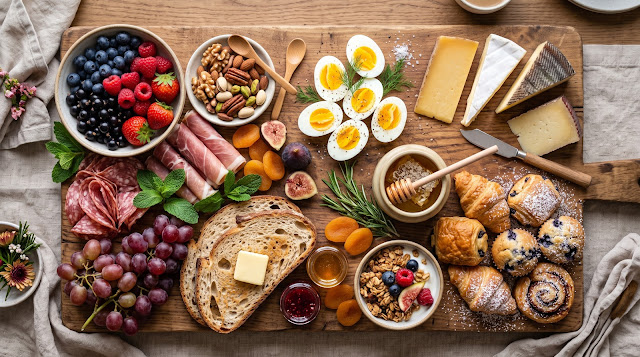
It’s become the centerpiece of what people are now calling the “Sunday reset” — that slower, softer version of the weekend that’s less about productivity and more about just feeling okay again before Monday. And it turns out the grazing board format isn’t just pretty. Built the right way, it does something a single plate of eggs on toast doesn’t: it keeps you full for hours, because you’re pulling from several different food groups instead of one.
Here’s the logic behind building one that actually works, plus five themed versions depending on the mood of your Sunday.

Why a Grazing Board Keeps You Full Longer Than a Plate
Most breakfast plates lean heavily on one macronutrient — carbs from toast, or protein from eggs, with everything else as an afterthought. A grazing board almost forces the opposite, because you’re naturally reaching for variety when you’re building it out visually. That variety is the actual mechanism behind why it works.
Protein and fat both slow gastric emptying — the rate at which food leaves your stomach — which is a big part of what makes you feel full rather than just “not hungry.” Fiber adds to that by absorbing water and expanding in your gut, adding physical bulk that triggers stretch receptors telling your brain you’ve had enough. A board that includes eggs or cheese (protein), fresh berries and nuts (fiber and healthy fats), and maybe a small pastry provides a balanced glucose curve that sustains your focus all morning.
The reverse is also true: chronic stress and anxiety increase inflammatory markers. Eating in a rushed, distracted state reduces digestive efficiency, making it harder to absorb the very nutrients you are consuming. The slow living context is not just an aesthetic; it is a metabolic necessity.

The Structure That Actually Works
A good board isn’t random. I think of it in four categories, and I try to hit all four before I even think about how it looks.
1. Protein Anchor
Hard-boiled or soft-boiled eggs, a wedge of good cheese, smoked salmon, or a small bowl of Greek yogurt. (If you want to prep your protein ahead, our highly popular High-Protein Egg Bites make the perfect, customizable addition to any Sunday spread). This is the piece doing the heaviest lifting for satiety, so don’t skip it in favor of just visual appeal.
2. Fiber and Whole Grains
Berries, sliced apple or pear, a few whole-grain crackers, or a small pile of granola. This is where most of the actual bulk and gut-friendly fiber comes from.
3. Healthy Fat
A handful of almonds or walnuts, a drizzle of honey over the cheese, or a few olives. Small amounts go a long way here — fat is calorie-dense, so this category should be the smallest on the board, not the largest.
4. Something Fresh and Something Sweet
Fresh herbs, a few edible flowers if you’re feeling it, a small square of dark chocolate or a tiny pastry. This category exists purely for pleasure, and that matters too — a board that’s all function and no joy isn’t one you’ll actually want to build again next Sunday.

Five Themed Boards
1. Protein-Forward
Hard-boiled eggs, a wedge of feta or a small bowl of cottage cheese, smoked salmon, cherry tomatoes, cucumber slices, and a few whole-grain crackers. Built for the mornings you need to stay full past noon.
2. Fruit-Heavy Summer Board
A mix of berries, sliced stone fruit, a small bowl of Greek yogurt with honey, a scatter of granola, and a few mint leaves for color. Lighter, but still anchored by the yogurt’s protein. (You can also layer your grains with fiber-rich seeds, like our Fibermaxxing Chia & Black Sesame Bowl, for an incredible dose of prebiotic fiber).
3. Savory Legume Board
This one leans into the international fusion breakfast trend that’s picking up steam right now — think warm butterbeans tossed in a little olive oil and harissa, a small bowl of yogurt to cool it down, flatbread, and a scatter of parsley. Legumes bring plant protein and a genuinely different texture to the board than the usual egg-and-cheese approach.
4. Fall-Spiced Board
Sliced apples and pears, a small dish of cinnamon-spiced walnuts, a wedge of sharp cheddar, dried figs, and a drizzle of maple syrup over everything. This is the one to save for when the weather actually turns, but there’s no rule against building it early if you’re craving it.

5. Minimalist Single-Serving Board
Not every Sunday calls for a full spread. A small plate with two eggs, a handful of berries, a few almonds, and one square of dark chocolate hits the same protein-fiber-fat structure at a fraction of the scale — good for solo mornings when the full board feels like more effort than the moment needs.

Making It an Actual Ritual, Not Just a Meal
The board itself takes maybe fifteen minutes to build once you’ve got the ingredients on hand. What makes it a ritual rather than a task is what happens around it — I set mine up while the coffee’s brewing, put my phone somewhere else in the apartment, and actually sit down at the table instead of eating standing up. Or try whisking a ceremonial green tea alongside using our Beginner’s Guide to Choosing Matcha to elevate the sensory cues of your morning.
If you’ve got people around, this is also the easiest version of hosting there is. Nobody’s plate needs to match anyone else’s, there’s no timing to coordinate between dishes, and everyone just picks at what they want.
Frequently Asked Questions
How far in advance can I prep a grazing board?
Most components hold well for a day if kept separate and covered — hard-boiled eggs, chopped fruit stored with a squeeze of lemon juice to prevent browning, and nuts in an airtight container. Assemble the board itself the morning you’re serving it, since things like cheese and cut fruit lose their texture and visual appeal if plated too far ahead.
Is a grazing board actually healthier than a cooked breakfast?
It depends entirely on what’s on it. A board built around the protein-fiber-fat structure above can be more balanced than a plate of just toast or pastries, but a board that’s mostly cheese, crackers, and jam isn’t automatically healthier just because it’s spread out and photogenic.
What’s the best board size for two people?
A board around 12-16 inches gives enough room for all four categories without excessive empty space. For more than four people, it’s usually easier to build two medium boards than one giant one — it keeps the food fresher and spreads people out around the table instead of crowding one spot.
Can I make a grazing board nut-free?
Yes — swap nuts for roasted chickpeas or pumpkin seeds to keep the crunch and fat categories covered without the allergen. The structure doesn’t depend on any single ingredient, just the role each category plays.
How do I keep the board from looking messy once people start eating?
Group items in small clusters rather than scattering everything evenly, and use small bowls for anything wet or crumbly, like yogurt or nuts. Clusters hold their shape as people pick from them, where a flat scatter falls apart after the first few minutes.
Some Sundays call for a full spread, some call for the minimalist version, and either way the point isn’t really the board. It’s the fifteen minutes before it, when you’re just standing in the kitchen with nowhere else to be.
Find more slow morning rituals and aesthetic recipes like this one on our Pinterest: @Nourish_Rituals
