
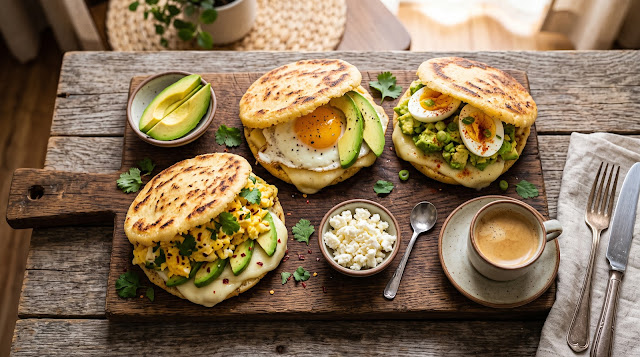
Breakfast is going international right now in a real way. People are moving past the standard eggs-and-toast rotation and pulling in dishes from other food cultures — shakshuka, congee, and now arepas, the Venezuelan cornmeal pockets that are quietly becoming one of the more interesting protein-and-fiber breakfast formats out there. It’s not a fusion gimmick. The format itself just happens to work exceptionally well for a stuffed, portable, endlessly customizable morning meal.

Why Corn Flour Behaves Differently Than Wheat
Arepas are made from precooked cornmeal, usually labeled masarepa, which is different from the masa used for tortillas or the cornmeal used for cornbread — it’s been cooked and dried already, which is what lets it form a dough with just water and salt, no rising time needed. That’s part of why this is such an easy weekday-morning food once you’ve made it a few times.
Corn flour is naturally gluten-free, which changes the texture entirely compared to a wheat-based bread or English muffin. Instead of the stretchy, airy crumb gluten creates, you get something denser and more substantial, with a fiber content that a plain wheat bread doesn’t have. That fiber, combined with whatever protein you stuff inside, is what gives arepas real staying power as a breakfast rather than something that leaves you hungry an hour later. If you want another satisfying, fiber-packed options, explore our signature The Ultimate Mindful Breakfast Avocado Toast.
Building the Base
The dough itself takes about five minutes to put together, and the resting time is what actually does the work — skip it, and the dough tends to crack around the edges when you shape it.

Base Recipe (makes 4 arepas)
2 cups (240g) masarepa (precooked white or yellow cornmeal)
2 1/2 cups (600ml) warm water
1 teaspoon salt
1 tablespoon oil or butter, for cooking
Whisk the salt into the warm water, then gradually add the masarepa, mixing with your hands as it comes together. Knead for about a minute until smooth, then let the dough rest for 5 minutes — this gives the cornmeal time to fully hydrate, which is what prevents cracking later. Divide into four balls, flatten each into a disc about half an inch thick, and smooth any cracked edges with wet fingers.
Cook in a lightly oiled pan over medium heat for about 5-6 minutes per side, until a golden crust forms. Then transfer to a 350°F (175°C) oven for 15-20 minutes, which finishes cooking the interior without burning the outside. Once they’re done, slice each one open like a pita and stuff it while it’s still warm.

Five Fillings
1. Classic Cheese
A soft, mild melting cheese like queso fresco or mozzarella, added while the arepa is still warm so it softens against the interior. This is the simplest version and the one most people start with.
2. Avocado-Egg
Half a scrambled or fried egg with sliced avocado and a pinch of flaky salt. The egg adds the protein the corn flour doesn’t have on its own, rounding out the fiber-protein balance that makes this filling breakfast rather than a snack.
3. Black Bean & Queso Fresco
Warm black beans mashed slightly with a fork, a sprinkle of queso fresco, and a few cilantro leaves. Beans stack another layer of fiber on top of what’s already in the corn, plus a meaningful hit of plant protein.
4. Smoked Salmon & Avocado
Smoked salmon, mashed avocado, and a squeeze of lime inside the arepa instead of on toast. The dense, slightly chewy arepa holds up to the salmon’s texture better than a soft bread would. If you love utilizing tinned and smoked fish for high-protein breakfasts, try our popular Sardine Toast Recipe.
5. Sweet Banana & Cinnamon
Sliced banana, a drizzle of honey, and a pinch of cinnamon, sometimes with a spoon of nut butter if you want more protein in the sweet version. Corn flour has a natural, mild sweetness that pairs better with fruit than people expect the first time they try it. Try enjoying it alongside our comforting Golden Milk Turmeric Latte for a warm, anti-inflammatory morning combination.

Making the Extra Batch Work for the Week
Cooked, unstuffed arepas keep well in the fridge for about 4 days, or in the freezer for up to two months. I usually make a double batch on a slower morning, then reheat one at a time through the week in a dry pan for a couple minutes per side to bring the crust back, before slicing and filling fresh. The dough itself doesn’t keep well raw, so it’s the cooked arepa you want to batch, not the dough.

Frequently Asked Questions
Can I use regular cornmeal instead of masarepa?
No, and this is the most common mistake people make on their first try. Regular cornmeal is raw and coarser, and it won’t form a cohesive dough with just water — you’ll end up with something crumbly that falls apart in the pan. Masarepa specifically has already been cooked and finely ground, which is what makes the dough workable.
Why did my arepa crack while shaping it?
Usually the dough didn’t rest long enough, or it needed a bit more water. Wetting your hands slightly while shaping helps smooth over small cracks, but if it’s cracking badly, work a little more warm water into the dough before trying again.
Are arepas actually gluten-free?
Yes, as long as the masarepa itself hasn’t been processed in a facility that also handles wheat — check the packaging if you’re cooking for someone with celiac disease specifically, but the corn flour itself contains no gluten.
Can I make the dough ahead of time?
It’s best made fresh, since raw dough dries out and becomes difficult to shape after a few hours in the fridge. What works better is cooking the full batch and reheating individual arepas through the week instead.
What’s the best way to reheat a stuffed arepa?
Reheat the arepa on its own in a dry pan first to bring back the crust, then add the filling fresh afterward. Reheating it already stuffed tends to make the filling either overcooked or unevenly warm by the time the arepa itself is hot.
This turned into one of those recipes where the format matters more than any single filling. Once the base is right, breakfast just becomes whatever you’re in the mood to tuck inside it.
Find more slow morning rituals and aesthetic recipes like this one on our Pinterest: @Nourish_Rituals
