
The 5-minute sensory grounding ritual is the fifth post in the 5-Minute Ritual series, and this one’s for the specific kind of dread that builds before a conversation you’ve been putting off — a difficult talk with a partner, telling someone news they won’t want to hear, walking into a conversation you know is going to be uncomfortable no matter how it goes. This isn’t about calming your body down the way the wind-down or grounding rituals in this series are. It’s about something slightly different: getting fully present, right here, right now, instead of stuck three imagined versions of a conversation that hasn’t happened yet.
Same five minutes, same real hands-on structure as the rest of the series — but this one borrows its actual technique from somewhere outside the kitchen entirely.

Jump to: Where this comes from · Why slow eating works · Building your 5-minute sensory grounding ritual · 4 variations · Closing out the series · FAQ
Where This Actually Comes From
Therapists who work with anxiety often teach a technique called sensory grounding, sometimes shorthanded as the 5-4-3-2-1 method — naming five things you can see, four you can touch, three you can hear, two you can smell, one you can taste. According to clinical research on sensory grounding and anxiety reduction, anticipatory anxiety lives almost entirely in imagined future scenarios, and deliberately pulling your attention into what’s physically happening around you right now interrupts that spiral, because your brain has a hard time fully rehearsing an imagined conversation and paying close attention to a real sensation at the same time.
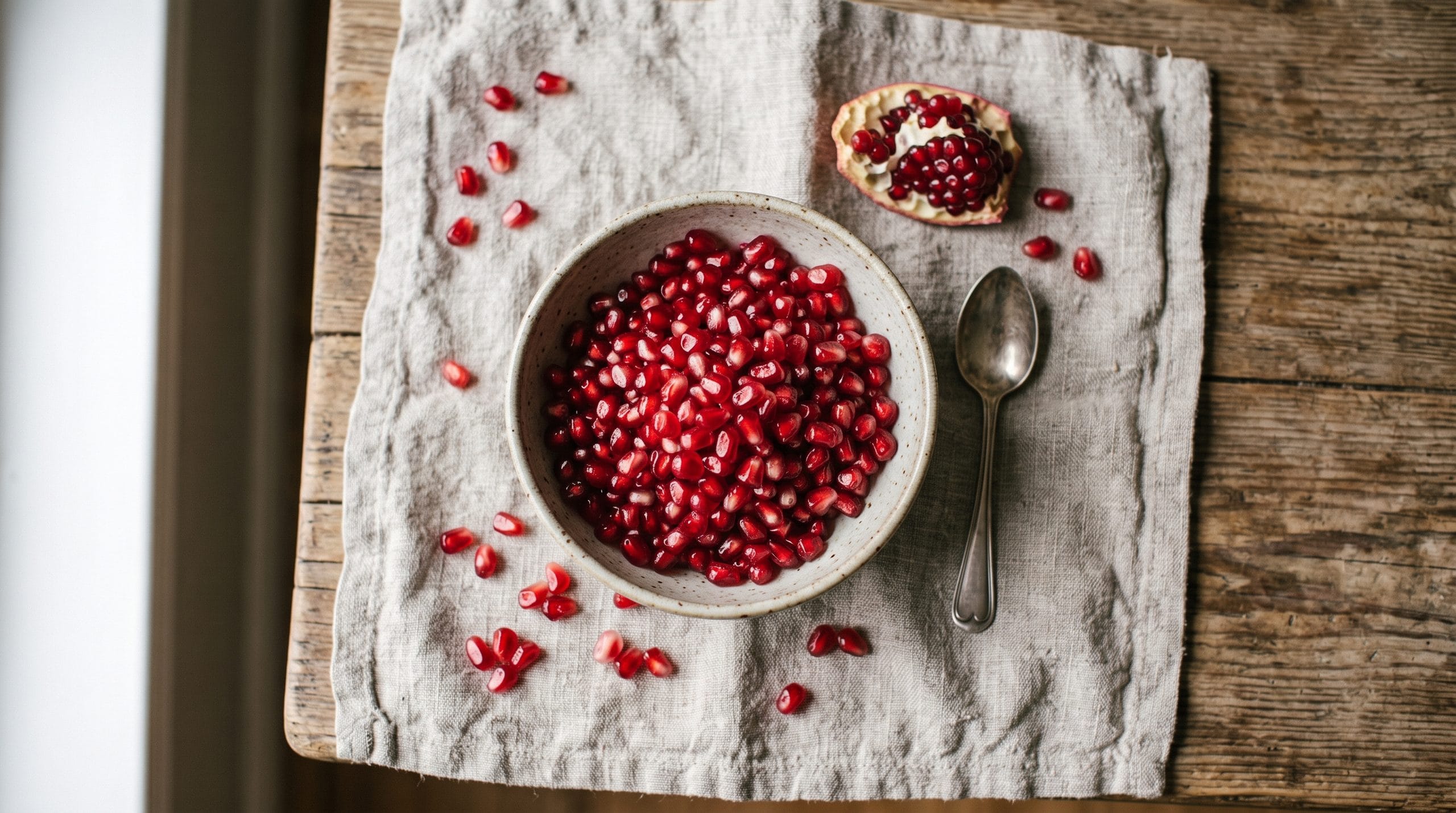
A pomegranate turns out to be an almost perfect single food to build that whole technique around, instead of needing to consciously catalog five separate things in the room. The color is genuinely striking to look at. The seeds have real texture and a small resistance before they burst. There’s an audible little pop when you bite into one. The scent is faint but distinct once you’re paying attention. And the taste itself is tart and layered enough to actually hold your focus for a moment, rather than being bland enough to eat on autopilot. One food, five senses, without needing to consciously assemble a whole checklist while you’re already anxious.

Why Slow, Deliberate Eating Works Better Than Distracted Eating
It’s worth being specific about why the pace matters here, since it’s easy to assume any snack before a hard moment does roughly the same job. Eating quickly or while distracted — scrolling, rehearsing what you’re about to say, pacing — keeps your attention exactly where the anxiety already lives: in your head, running future scenarios. Eating slowly and paying attention to texture, sound, and taste forces your attention into your body and the present moment instead, which is the entire mechanism this technique depends on. The food itself is almost incidental. What matters is that it gives your attention somewhere concrete and immediate to land.
Building Your 5-Minute Sensory Grounding Ritual
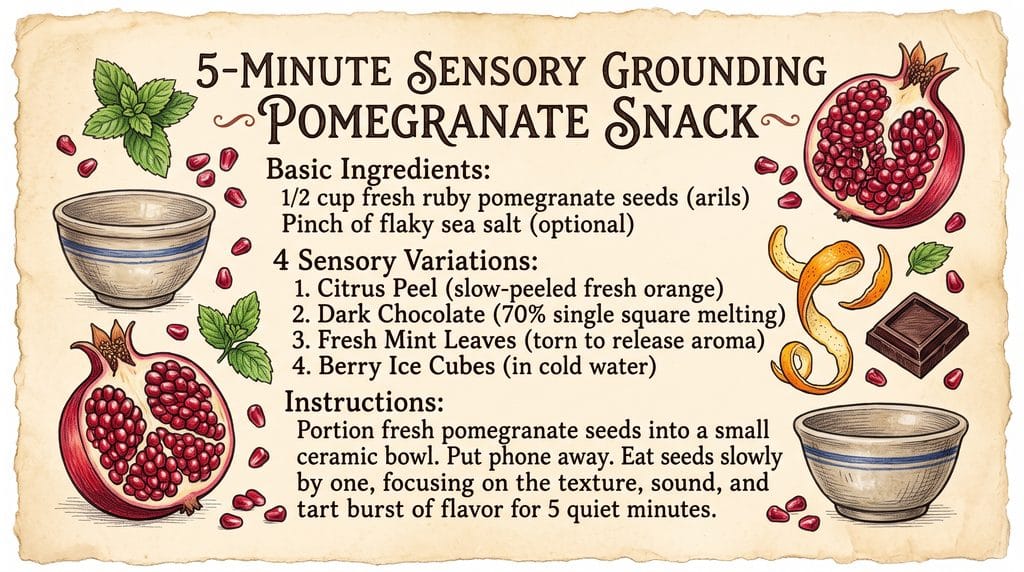
Portion a small bowl of pomegranate seeds — fresh if you’re deseeding your own, or the pre-packaged kind if you need this to genuinely take five minutes and not fifteen. Sit down somewhere quiet, phone face-down or in another room entirely.

Before eating anything, just look at the bowl for a few seconds — really look, not glance. Then eat the seeds slowly, one at a time if you can manage it, paying actual attention to the small pop of texture and the tartness of each one rather than eating on autopilot while thinking about the conversation ahead. That’s the whole ritual. It’s less about the pomegranate being special and more about using it as an anchor to stay present in your body for five minutes before you have to be present with another person.
4 Variations if Pomegranate Isn’t Available
Citrus version — peel an orange slowly by hand instead of pre-cut, paying attention to the scent released as you peel and the texture of pulling each segment apart.
Dark chocolate and sea salt — let a single square melt slowly on your tongue instead of chewing it, noticing how the flavor changes as it melts and the salt hits partway through.

Fresh mint — a few leaves, torn rather than whole, to release more scent, chewed slowly. Good if you want something that engages smell more than taste.
Ice cubes with fruit — a small glass of ice with a few berries frozen inside works well for the touch and sight components especially, taking inspiration from our DIY aesthetic ice cubes with fruit.
Closing Out the Series
This is the fifth and, for now, the last post in the 5-Minute Ritual series — five different moments, five different mechanisms, all built on the same simple idea: five real minutes, tied to something specific happening in your day, done on purpose instead of on autopilot. The 5-minute wind-down ritual leaned on magnesium and tryptophan to ease toward sleep. The 5-minute focus ritual used protein and blood sugar stability to keep you sharp without a crash. The 5-minute recovery ritual timed carbohydrate and protein to a real physiological window after exercise. The 5-minute grounding tea ritual used warmth and breath to calm an overwhelmed nervous system mid-day. And this 5-minute sensory grounding ritual uses a single food’s full sensory range to pull you out of anticipation and into the present moment, right before you need it most.
None of these are complicated. That’s really the whole point of building them this way — five minutes is short enough that there’s no good excuse not to do it, and specific enough that it actually does something, rather than being a vague suggestion to “take a moment for yourself.”
Frequently Asked Questions
Does this actually reduce anxiety about the conversation itself?
It won’t change what you need to say or how the other person responds, but it can meaningfully reduce the anticipatory spiral beforehand, which often makes people walk into hard conversations more reactive and less clear-headed than they’d otherwise be.
Why pomegranate specifically, and not something simpler?
Simpler foods work too, but pomegranate happens to naturally engage more senses at once — sight, sound, texture, scent, and taste — without needing you to consciously seek each one out separately, which matters when you’re already anxious and don’t have much bandwidth for a complicated exercise.
Can I do this technique without any food at all?
Yes — sensory grounding doesn’t require food specifically, and the classic 5-4-3-2-1 version uses whatever’s in the room around you. Food just happens to be an easy, portable way to hit several senses at once without having to think too hard about what to look at, touch, and listen for separately.
What if I only have a minute or two before I need to go in?
Even thirty seconds of genuinely slow, attentive eating captures some of the benefit. It’s the quality of attention that matters most here, not the exact clock time.
Is this useful for anxiety beyond just hard conversations?
Sensory grounding techniques are commonly used for general anxiety and panic as well, not just conversation-specific dread. If anxiety is a frequent or significant part of your life, it’s worth bringing up with a therapist, who can build on a simple technique like this with more structured support.

That’s the full 5-Minute Ritual series for now — find all five, plus everything else, over on @Nourish_Rituals.
