
Understanding why onions make you cry comes with every kitchen having its own theory: freeze the onion, chew gum, cut it underwater, light a candle, wear swim goggles. Some of these genuinely work. Some do almost nothing and just happen to distract you long enough that you stop noticing the sting until it’s already over. The difference comes down to actually understanding what’s happening at a chemical level the moment your knife hits an onion — and once you know the mechanism, it’s obvious which fixes are addressing the actual cause and which are just kitchen folklore.

Jump to: The actual chemistry · Why some onions are worse · Which fixes actually work · The combined method · FAQ
The Real Chemistry Behind Why Onions Make You Cry
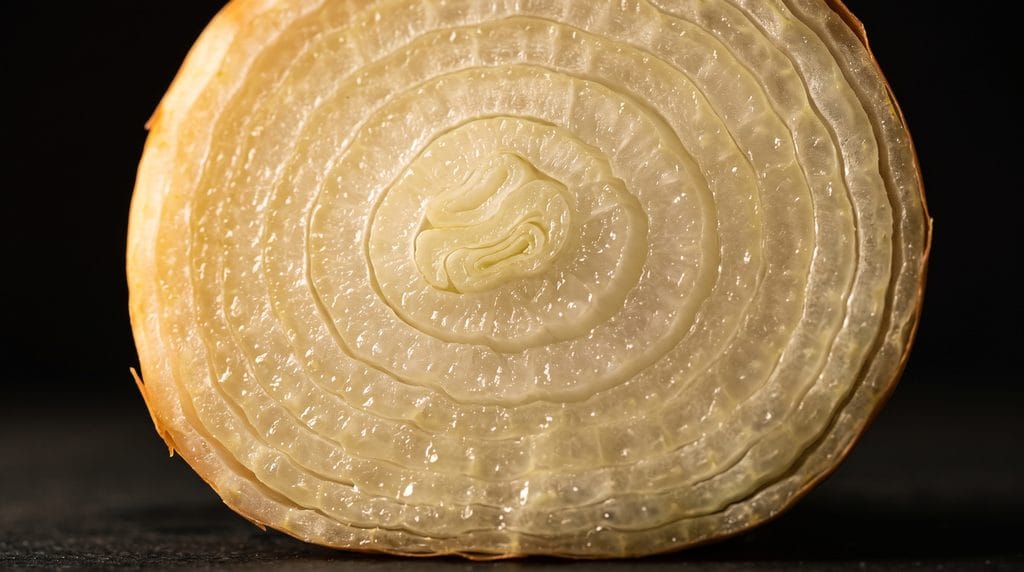
Onions store two separate compounds in different parts of their cells: sulfur-containing amino acid derivatives called sulfoxides, and an enzyme called alliinase. In an intact, uncut onion, these two things never touch — the sulfoxides sit inside the cell, while the enzyme is stored separately. The moment you slice through the onion, you rupture thousands of cells at once, and the enzyme and sulfoxides finally mix.
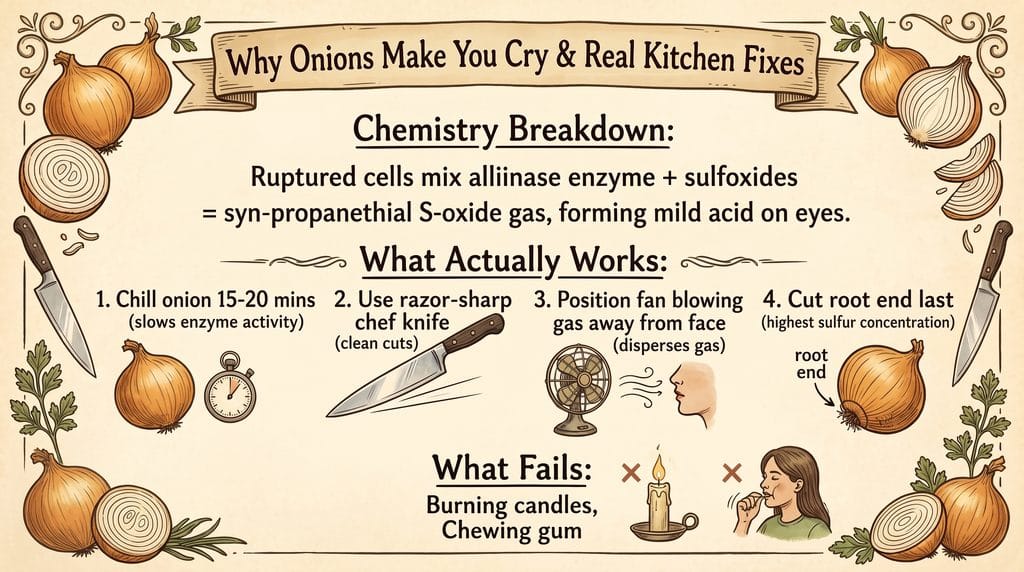
According to chemical research on onion lachrymatory factor synthase and volatile sulfur compounds, that reaction produces an unstable compound that rearranges itself almost instantly into a gas called syn-propanethial S-oxide — the actual irritant. It’s volatile enough to drift upward from the cutting board straight into the air around your face, where it reaches your eyes before you’d even notice a smell.
Why It Specifically Makes You Cry, Not Just Sting
Once that gas reaches the surface of your eye, it reacts with the water in your tears to form a diluted sulfuric acid — literally, a mild acid forming directly on your eyeball. Your eyes respond to that irritation the only way they know how: by flushing it out with more tears, which is your body’s defense mechanism working exactly as designed, just at an inconvenient moment. The more cells you rupture quickly — meaning the faster and more forcefully you cut — the more gas gets released at once, which is a big part of why a dull knife makes you cry more than a sharp one, a knife-skill principle we emphasize when prepping vegetables for our crispy cabbage breakfast hash.
Why Some Onions Are Worse Than Others
Not all onions produce the same amount of the crying compound, and this comes down to how much sulfur the plant absorbed from the soil it grew in. Onions grown in sulfur-rich soil — which describes a lot of commercially farmed yellow and white onions — tend to produce noticeably more of the irritant gas than onions grown in lower-sulfur conditions. This is also the real reason sweet onions like Vidalia or Walla Walla barely make you tear up at all: they’re grown specifically in low-sulfur soil, not because they contain less sugar than other onions, which is a common misconception. Red onions and shallots tend to fall somewhere in the middle.
Which Fixes Actually Work (and Which Don’t)
Chilling the Onion — Works
Cold temperatures slow down enzyme activity, including alliinase. A colder onion produces the irritant gas more slowly, giving it more time to disperse into the air before concentrating near your face. Fifteen to twenty minutes in the fridge, or even the freezer for a few minutes right before cutting, makes a real, measurable difference.
Using a Sharp Knife — Works
This is less about the chemistry of the gas and more about cell damage. A sharp knife slices cleanly through cell walls, rupturing far fewer cells per cut than a dull blade, which tends to crush and tear cells rather than cut them cleanly. Fewer ruptured cells means less enzyme-sulfoxide mixing, which means less gas.
Cutting Near Running Water or a Fan — Works, With a Catch
Moving air genuinely helps disperse the gas before it reaches high enough concentration near your eyes to trigger the acid reaction. A fan angled away from your face, blowing the gas in the opposite direction, is one of the more reliably effective tricks. Cutting directly under running water works on the same principle but is impractical for actually getting clean knife cuts, unlike the simple soaking methods we use in our guide to reviving stale bread in the oven.

Lighting a Candle Nearby — Weak Evidence, Probably Placebo-Adjacent
The theory is that the flame burns off some of the gas before it reaches your eyes. In practice, the amount of gas a burning candle can realistically combust in the small radius near your cutting board is minimal compared to how much is drifting past it. Most kitchen science writers who’ve tested this consider it more folklore than functional fix.
Chewing Gum — No Real Mechanism
This one is popular but doesn’t have a clear chemical explanation. The leading theory is that breathing through your mouth while chewing reduces how much gas reaches your nasal passages, which some people associate (inaccurately) with the eye irritation itself — but the compound irritates your eyes directly through the air, not through your nose, so this doesn’t address the actual cause.
Wearing Goggles or Glasses — Works, Just Not Elegant
This is the most literal fix, and it works precisely because it blocks the gas from ever reaching your eyes at all rather than trying to reduce the amount produced. Swim goggles are the most-cited version online, and while it looks slightly ridiculous, it’s genuinely one of the most effective options if you’re chopping a large batch of onions at once.
The Method That Combines the Real Fixes
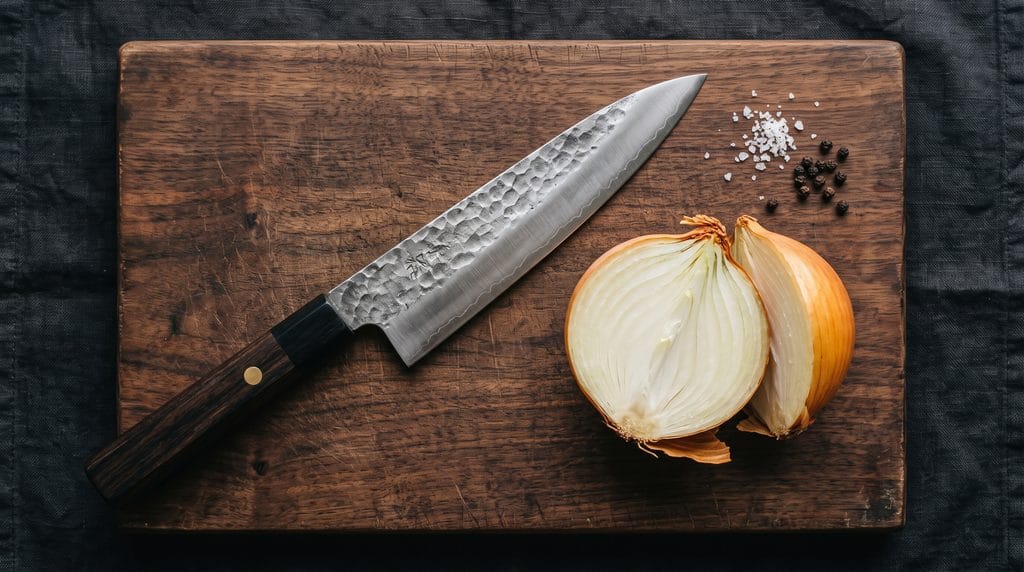
If onion tears genuinely bother you, stacking the fixes that have an actual mechanism behind them works far better than relying on just one. Chill the onion for fifteen minutes, use the sharpest knife in your kitchen, and position a small fan to blow air away from your face while you cut. Each one independently reduces either how much gas is produced or how much reaches your eyes, and together they noticeably cut down on tearing without needing goggles at the counter, fitting seamlessly into mindful minimalist kitchen habits and smart pantry organization.
Frequently Asked Questions
Does cutting off the root end first help?
There’s some truth here — the root end has the highest concentration of the compounds that trigger the reaction, so cutting it last, rather than first, means you’re exposed to the most irritating part for the shortest time.
Why do some people barely tear up at all while others cry immediately?
Individual sensitivity to the compound varies, along with how close your face naturally sits to the cutting board while you work. Taller cooks or those who lean in less tend to notice it less simply due to distance from the gas source.
Is the gas from onions actually harmful to breathe?
No — it’s irritating in the concentrations produced by home cooking, but not toxic or dangerous. The same defensive tearing response would happen with any similarly irritating airborne compound.
Does microwaving an onion briefly before cutting reduce tears?
Yes, brief heat can denature some of the alliinase enzyme, reducing gas production, but it also starts to cook the onion slightly, changing its texture — most cooks find chilling a better trade-off than heating.
Why don’t cooked onions make anyone cry?
Heat during cooking denatures the alliinase enzyme completely, stopping the reaction that produces the irritant gas entirely. Once an onion is cooked, the chemistry that causes tearing simply can’t happen anymore.
Does the type of cutting board or knife material make any difference?
No — the board material is irrelevant to gas production, since the reaction happens inside the onion’s own cells the instant they’re ruptured, not from any contact with the cutting surface. Knife sharpness matters far more than what the knife or board is made of, because a clean cut through fewer cell walls is what limits how much enzyme and sulfoxide end up mixing at once.
If little kitchen-science breakdowns like this are your thing, I’m sharing more daily on Pinterest — come save this one for later.