
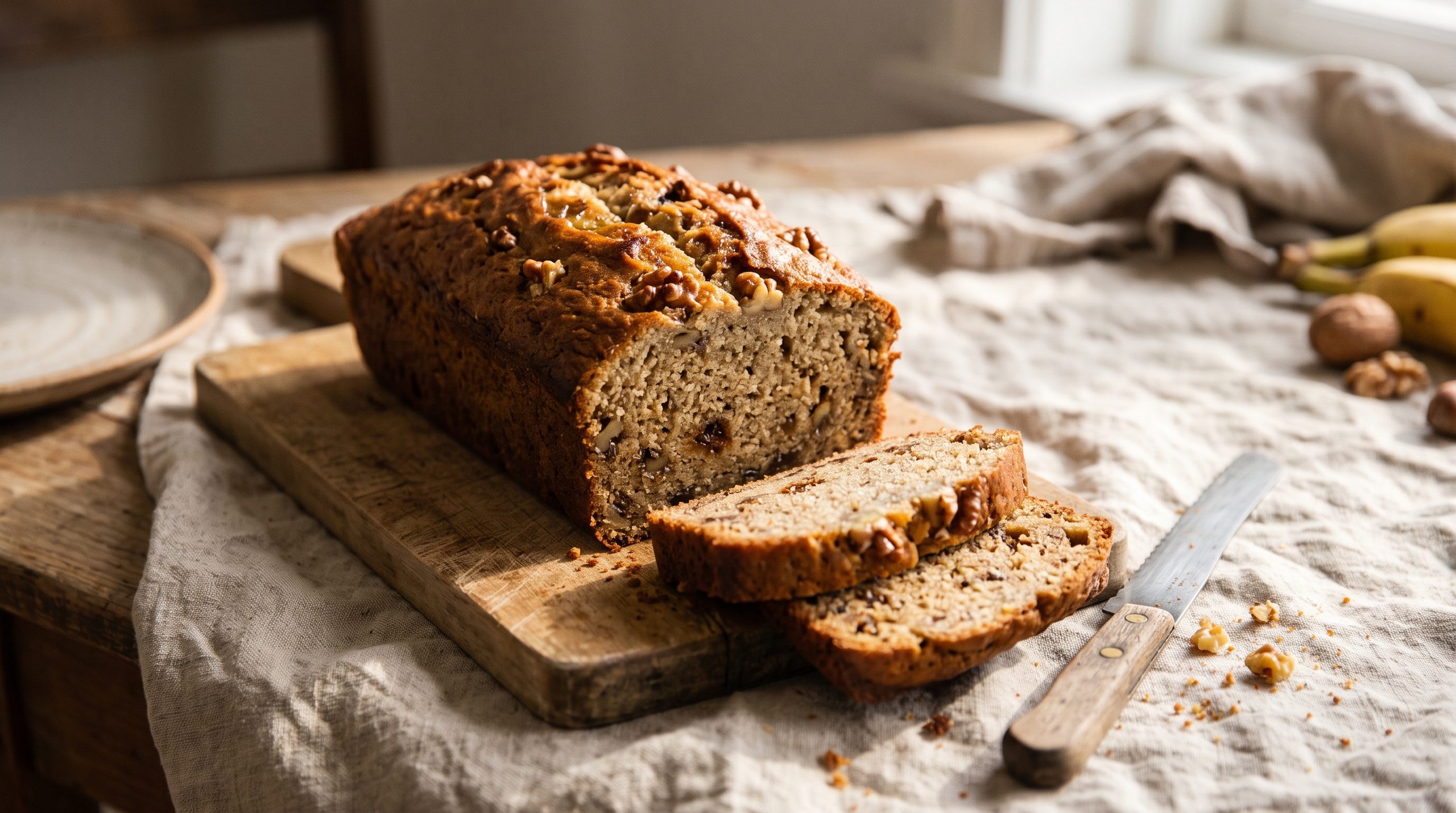
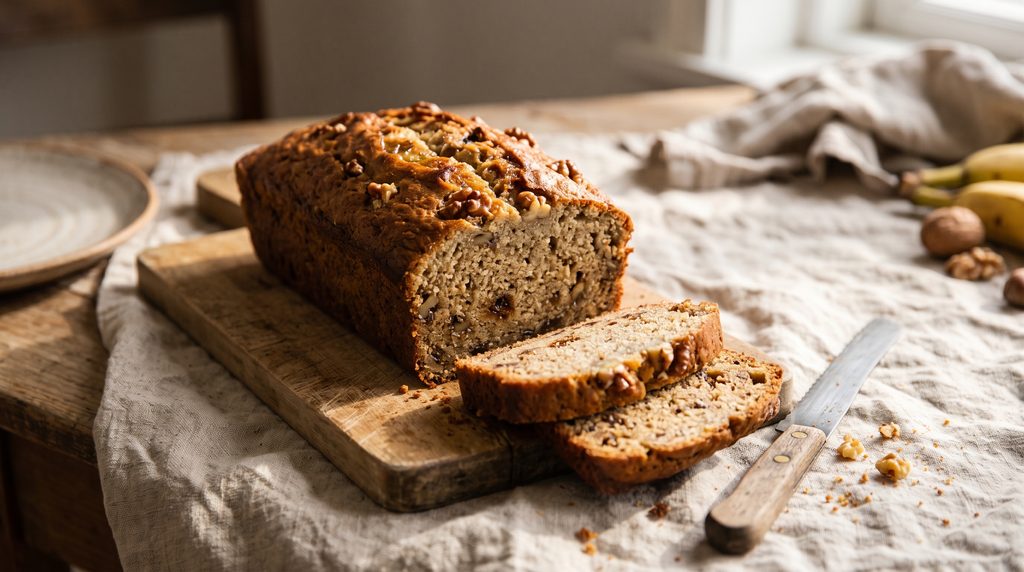
Baking the best banana bread recipe is one of those pursuits people search for in every decade, in every country, usually with a sad bunch of blackening bananas sitting on the counter. That constant demand is exactly why there are ten thousand versions of it, and why most of them are merely fine: a little dry, a little dense, tasting of sweetness more than of banana. The difference between fine and unforgettable isn’t a secret ingredient. It’s three pieces of kitchen chemistry that almost no recipe bothers to explain.
Jump to: Why bananas must be black · Why baking soda, not powder · The best banana bread recipe · Why overmixing ruins bread · Troubleshooting · 4 variations · FAQ
Why the Bananas Need to Be Almost Black
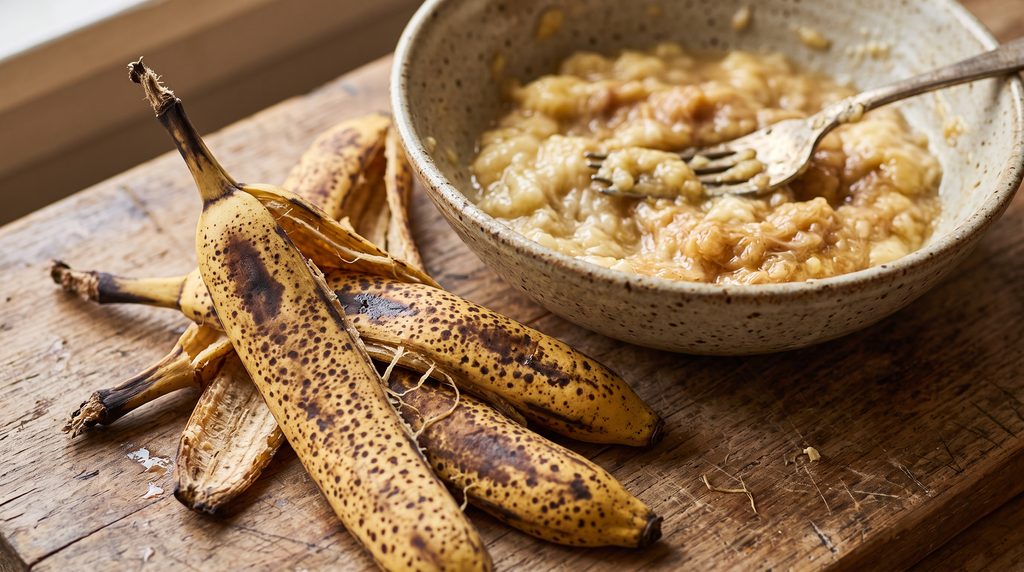
As a banana ripens, enzymes break down its starch into simple sugars. A green banana is mostly starch, which is why it tastes chalky and bland. A fully yellow banana is partway through the conversion. A heavily speckled or black-skinned banana has converted nearly all of it, which means more sugar, softer flesh, and a much louder banana flavor. According to food biochemistry research on banana starch-to-sugar conversion and ester volatiles, ripening climbs steeply in the final senescence stage, releasing aromatic volatile esters that define true banana aroma.
That’s the reason a loaf made with pale yellow bananas tastes flat no matter how much sugar you add. You can’t put in the flavor compounds by sweetening; the fruit has to produce them itself. If your bananas are still green, you can easily accelerate the process using the natural ethylene gas principles in our guide on how to ripen fruit with bananas.
Mashing for Moisture
Mash the bananas thoroughly but leave a few small lumps. Banana flesh is roughly three-quarters water, and that water is the main moisture source in the loaf. A smooth, well-mashed banana distributes evenly through the batter, so the crumb bakes up uniformly tender instead of having wet streaks and dry patches.
Why Baking Soda, Not Baking Powder
Ripe bananas are mildly acidic. Baking soda is a base, and when it meets an acid in a wet batter it releases carbon dioxide gas, which makes the loaf rise. Because the bananas supply the acid, baking soda alone is enough, and it does a second job: it raises the batter’s pH slightly, which speeds up browning reactions in the oven. That’s why banana bread made with baking soda gets a deeper, more caramelized crust than one leavened with baking powder alone.
Don’t let the batter sit around once the soda is in. The reaction starts immediately, and gas that escapes in the bowl is gas that doesn’t lift the loaf. Mix, pour, bake.
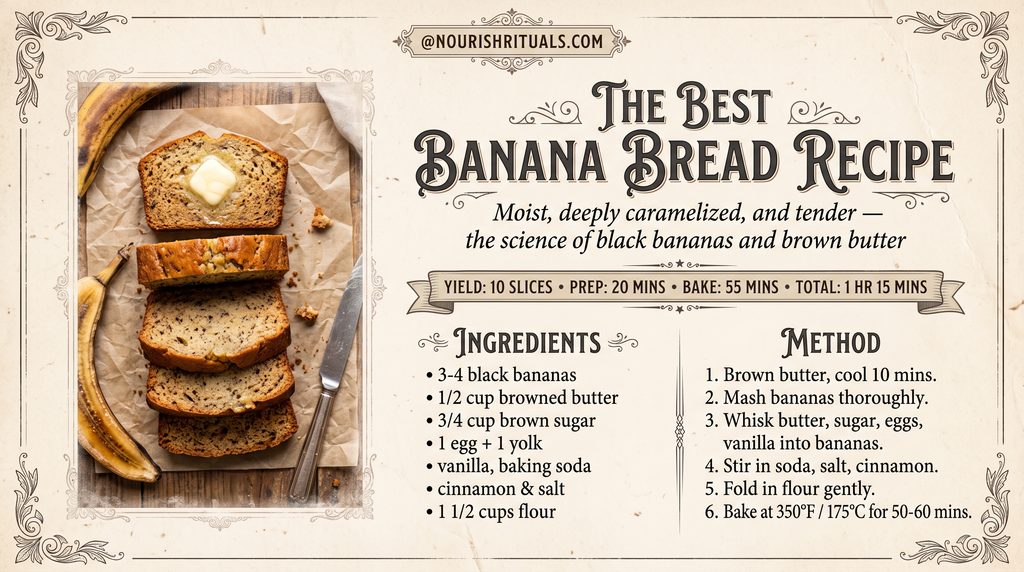
The Best Banana Bread Recipe
Ingredients:
- 3–4 very ripe bananas (about 1 1/2 cups mashed)
- 1/2 cup (1 stick) unsalted butter
- 3/4 cup packed brown sugar
- 1 large egg, plus 1 egg yolk
- 1 teaspoon vanilla extract
- 1 teaspoon baking soda
- 1/2 teaspoon salt
- 1/2 teaspoon ground cinnamon
- 1 1/2 cups all-purpose flour
- Optional: 1/2 cup chopped walnuts or chocolate chunks
Method:
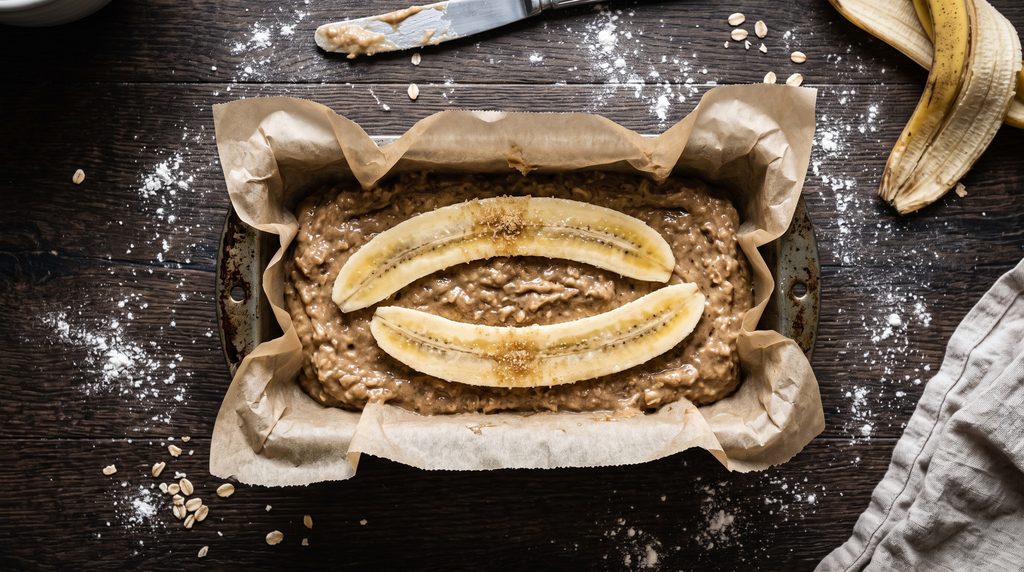
- Heat the oven to 350°F (175°C) and line a 9×5-inch loaf pan with parchment, leaving an overhang so you can lift the loaf out.
- Brown the butter in a light-colored pan over medium heat until it smells nutty and shows golden-brown flecks, then let it cool for about 10 minutes. Browning toasts the milk solids and creates toffee-like flavor compounds through the Maillard reaction, applying the same nutty fat transformation we use in our brown butter chocolate chip cookies.
- Mash the bananas in a large bowl.
- Whisk in the cooled butter, brown sugar, egg, egg yolk, and vanilla. The extra yolk adds richness and an emulsifier without adding much water.
- Stir in the baking soda, salt, and cinnamon.
- Fold in the flour with a spatula, only until the last streaks disappear. This is the step that decides whether your loaf is tender or tough. Flour plus water plus stirring builds gluten, and in a quick bread, extra gluten makes the crumb chewy and tunnel-ridden. Fold gently, stop early, and fold in any nuts or chocolate at the very end.
- Pour into the pan and bake 50–60 minutes, until a skewer in the center comes out clean or with a few moist crumbs. If the top browns too fast, tent it with foil for the last 15 minutes.
- Cool in the pan 15 minutes, then lift out onto a rack. Wait at least 30 minutes before slicing; the crumb is still setting as it cools, and cutting too early gives a gummy slice.
Why Overmixing Is the Quiet Killer
Most dry banana bread has the same cause: the batter was stirred until smooth, like a cake. Quick breads are the opposite of yeast bread. You don’t want an elastic network, you want short, tender strands. When you overmix, the flour proteins link into long gluten sheets that bake into a tight, rubbery structure and push moisture out of the crumb. A lumpy, barely combined batter looks wrong but bakes right.
Troubleshooting
My loaf sank in the middle. Usually the oven was too cool, the batter sat too long after adding soda, or the loaf came out before the center set. Check doneness with a skewer, not just the top color.
It’s gummy near the bottom. That’s often underbaking or too many wet bananas. Weigh your mashed banana; much more than 1 1/2 cups adds extra water the flour can’t absorb.
The top burned before the middle cooked. Tent with foil partway through, and make sure your oven isn’t running hotter than its display says.
It tastes bland. Your bananas weren’t ripe enough, or the salt was skipped. Salt sharpens the sweetness and makes the banana flavor read as stronger, following our favourite sweet-salty balance in swalty snacks.
Four Variations Worth Trying
Chocolate chunk banana bread — fold in 3/4 cup chopped dark chocolate. Chopped bar chocolate gives melty pools instead of uniform dots.
Walnut and cinnamon swirl — layer half the batter, sprinkle cinnamon sugar and chopped walnuts, add the rest, and swirl once with a knife.
Tahini banana bread — replace 2 tablespoons of the butter with tahini and finish with sesame seeds for a nutty, slightly savory depth.
Brown sugar oat crumble top — mix oats, brown sugar, butter, and cinnamon into a crumble and press it onto the batter before baking for a bakery-style top.
FAQ
Can I use frozen bananas?
Yes, and they’re often excellent, since freezing breaks down cell walls and makes them extra soft. Thaw them fully and use all the liquid that collects, since it’s concentrated banana flavor.
Why does my banana bread have a gummy streak?
Usually uneven mashing, which leaves wet pockets, or overmixing. Mash well, fold gently, and let the loaf cool before cutting.
Can I make it with oil instead of butter?
You can, and it stays moist longer. You lose the nutty browned butter flavor, but gain a slightly softer crumb that holds for days.
How do I store banana bread?
Wrap it tightly and keep it at room temperature for up to three days. For longer storage, slice and freeze it, then toast slices straight from frozen, keeping your pantry organized in aesthetic glass jar pantry containers.
Can I reduce the sugar?
Modestly, by about a quarter. Sugar also holds moisture and aids browning, so large cuts make the loaf drier and paler.
If cozy, science-backed baking like this is your thing, I share more slow-living kitchen ideas daily on Pinterest — come save this one for later.
